Lucilius Press › Reading guides
What order should you read the Stoics in?
Start with Epictetus' Handbook, because it is short and lays out the core idea plainly. Then read Marcus Aurelius' Meditations, which is that idea put into practice. Then Seneca's Letters to Lucilius, slowly. After that, Musonius Rufus, Epictetus' teacher, and finally the fragments of the early Stoics, Zeno, Cleanthes and Chrysippus, who founded the school.
A reading order that works
1. Epictetus, the Handbook. About fifty short chapters. It opens with the division between what is up to us and what is not, and everything else follows from that. An afternoon's read. Our summary of the Handbook.
2. Marcus Aurelius, Meditations. An emperor reminding himself of the same ideas, under real pressure. Dip in rather than reading straight through. Which translation to choose.
3. Seneca, Letters to Lucilius. The warmest and widest of the Stoic writers. A letter a day is a good pace. What the letters cover.
4. Epictetus, the Discourses. The longer classroom talks behind the Handbook, livelier than you might expect.
5. Musonius Rufus. Short practical lectures by Epictetus' teacher. About the lectures.
6. The early Stoics. What survives of the founders, for when you want to know where it all started. What survives of Zeno.
If you only read one, read the Handbook.
Where to start, today
Epictetus: The Stoic Handbook and Discourses is a modern plain-English translation of the Handbook, the four surviving books of the Discourses and the fragments, with short introductions and a glossary. Here is one of the Handbook's best-known chapters.
5. It is not things that upset people, but their judgments about things. Death, for instance, is nothing dreadful, or it would have seemed so to Socrates too; it is the judgment that death is dreadful that is the dreadful thing. So whenever we are blocked, or upset, or grieved, let us never blame anyone but ourselves, that is, our own judgments. It is the act of an untrained person to blame others when things go badly for him; of someone who has started his training to blame himself; and of someone fully trained to blame neither anyone else nor himself.
From Epictetus: The Stoic Handbook and Discourses, translated by Owen Halloway, Lucilius Press. Enchiridion 5. Free sample, reproduced from the book.
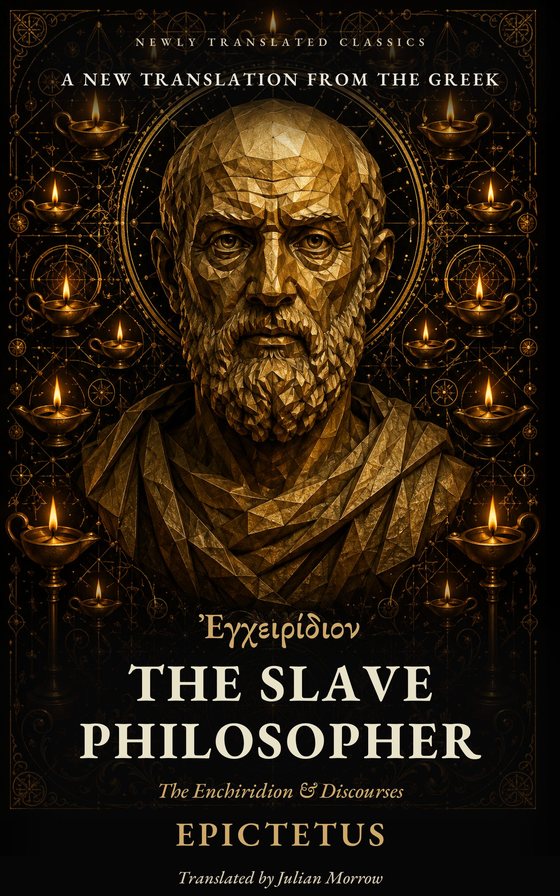
Epictetus: The Stoic Handbook and Discourses
Translated by Owen Halloway