Lucilius Press › Reading guides
Diogenes Laertius' Lives of the Eminent Philosophers in readable English
The Lives of the Eminent Philosophers is a collection of short biographies of Greek thinkers, from Thales to Epicurus, in ten books, probably written in the third century AD. It is full of gossip, sayings, letters, wills and doctrine summaries. It is also our main source for Epicurus' letters. A readable modern translation makes it a book you can dip into for months.
English versions
C. D. Yonge (1853). The older public-domain translation, free online, in the prose of its time.
R. D. Hicks, Loeb Classical Library, two volumes (1925). Greek facing the English. The one most often cited.
Pamela Mensch, edited by James Miller (Oxford University Press). A modern translation in a large illustrated volume with essays.
The Lucilius Press edition
Diogenes Laertius: Lives of the Eminent Philosophers is a modern plain-English translation of all ten books, with an introduction. Each philosopher is a short chapter, so it reads well a life at a time. Here are some of the sayings it gives for Thales, the first of the sages.
Of all things that are, the eldest is God, for he is uncreated. Fairest is the cosmos, for it is God’s work. Greatest is space, for it holds all things. Swiftest is mind, for it runs through everything. Strongest is necessity, for it masters all. Wisest is time, for it discovers all things.
He said that death is no different from life. “Then why,” someone said, “do you not die?” “Because,” he said, “it makes no difference.”
To one who asked which came first, night or day, he said, “Night, by one day.” Someone asked him whether a man doing wrong could escape the notice of the gods. “No,” he said, “not even one intending it.” To an adulterer who asked whether he should swear he had not committed adultery, he said, “Perjury is no worse than adultery.” Asked what is difficult, he said, “To know oneself”; what is easy, “To advise another”; what is most pleasant, “To succeed”; what is the divine, “That which has neither beginning nor end.” Asked what strange thing he had seen, he said, “A tyrant grown old.” Asked how one might most easily bear misfortune, he said, “If he sees his enemies faring worse.” And how we might live best and most justly, “If we ourselves do not do what we blame in others.”
From Diogenes Laertius: Lives of the Eminent Philosophers, translated by Owen Halloway, Lucilius Press. Book One, Thales. Free sample, reproduced from the book.
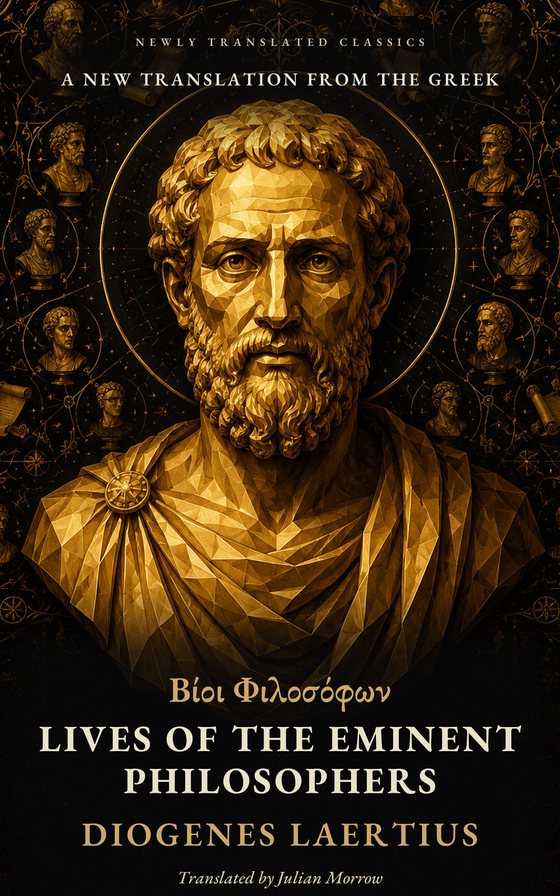
Diogenes Laertius: Lives of the Eminent Philosophers
Translated by Owen Halloway