Lucilius Press › Reading guides
Diogenes the Cynic's sayings, and where they come from
Diogenes of Sinope left no writings that survive, so every quote of his is a report. Most come from Book Six of Diogenes Laertius' Lives of the Eminent Philosophers, written roughly five hundred years later. The famous ones are there: telling Alexander the Great to get out of his light, and walking with a lamp in daylight looking for a man.
Why the source matters
Many lines attributed to Diogenes online have no ancient source at all. The safe test is whether a saying can be traced to an ancient writer, usually Diogenes Laertius, sometimes Plutarch or others. Even then, these are anecdotes that grew in the telling, and the ancient writers themselves often say "they say" or "some attribute this to" someone else.
A few of the best-attested
Against fortune he set courage, against convention nature, against passion reason. Alexander stood over him and offered him anything; he asked him to get out of his light. He lit a lamp in daylight and went about saying he was looking for a man. Asked why he was called a dog, he said he fawned on those who gave, barked at those who did not, and bit the wicked.
Where to read them
Robin Hard's Diogenes the Cynic: Sayings and Anecdotes, with Other Popular Moralists (Oxford World's Classics, 2012) is a well-known collection. The Lucilius Press edition, The Cynics: Diogenes, Crates and Hipparchia, is a modern plain-English translation of the ancient lives and sayings of the Cynics, with essays on the main figures and a glossary. Here is a stretch of the life of Diogenes as it appears in the book.
But he said that against fortune he set courage, against convention nature, and against passion reason. While he was sunning himself in the Craneion, Alexander stood over him and said, “Ask me for whatever you want.” And he said, “Get out of my light.” A man was reading aloud at great length, and when he showed the blank space at the end of the roll, Diogenes said, “Take heart, men: I see land.” To the man who proved by a syllogism that he had horns, he touched his forehead and said, “Well, I don’t see any.”
He lit a lamp in broad daylight and went about saying, “I am looking for a man.”
From The Cynics: Diogenes, Crates and Hipparchia, translated by Owen Halloway, Lucilius Press. Life of Diogenes, sections 38 and 41. Free sample, reproduced from the book.
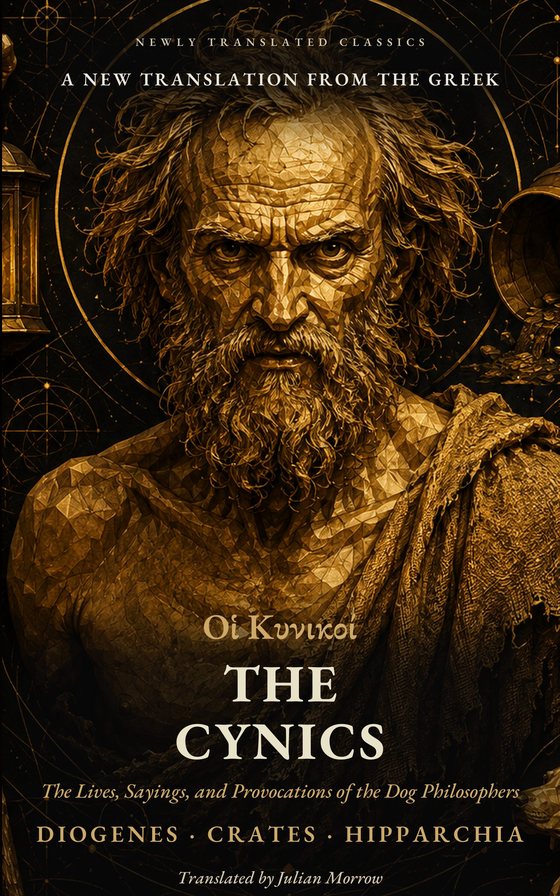
The Cynics: Diogenes, Crates and Hipparchia
Translated by Owen Halloway