Lucilius Press › Reading guides
Diogenes of Oenoanda's fragments in English
Diogenes of Oenoanda, also spelled Oinoanda, was a wealthy Epicurean who, in the second century AD, had a long summary of Epicurus' teaching carved on a stone colonnade in his hill town in what is now southwest Turkey. The wall was later broken up. Its blocks are still being dug out and read, so the fragments keep growing.
What the wall says
Diogenes explains why he did it: most people are sick with false beliefs, and he wanted to put the remedy where anyone passing by could read it, including strangers and people not yet born. Then come treatises on physics, the gods and ethics, a piece on old age, letters, and maxims of Epicurus.
In English
The standard scholarly edition is Martin Ferguson Smith's Diogenes of Oinoanda: The Epicurean Inscription (Bibliopolis, 1993), with the Greek, a translation and notes. Smith has kept publishing newly found blocks since.
The Lucilius Press edition
After the Garden: Philodemus and Diogenes of Oenoanda is a modern plain-English translation that pairs the wall with a selection of works by the Epicurean Philodemus. Gaps in the stone are shown as gaps, never filled with invented words. Here is Diogenes explaining why he built the wall.
If one man only were in a bad way, or two, or three, or four, or five, or six, or however many more than that you like, my friend, so long as it were not really a great many, I would have called them in one at a time and
col. IV
done everything in my power to give them the best advice. But since, as I said before, most people are sick in common with false beliefs about things, as though in a plague, and their number keeps growing (for through copying one another they catch the disease from each other, like sheep), and since it is right to help those who will come
col. V
after us as well (they too are ours, even though they have not yet been born), and since besides it is a mark of love for humanity to give aid to the strangers who pass through: since, then, by this route the help this writing gives has crossed over to a greater number, I chose to put the drugs of our deliverance up on this colonnade, out in the open and common to all.
From After the Garden: Philodemus and Diogenes of Oenoanda, translated by Owen Halloway, Lucilius Press. The Fragments of the Wall, columns III to V. Free sample, reproduced from the book.
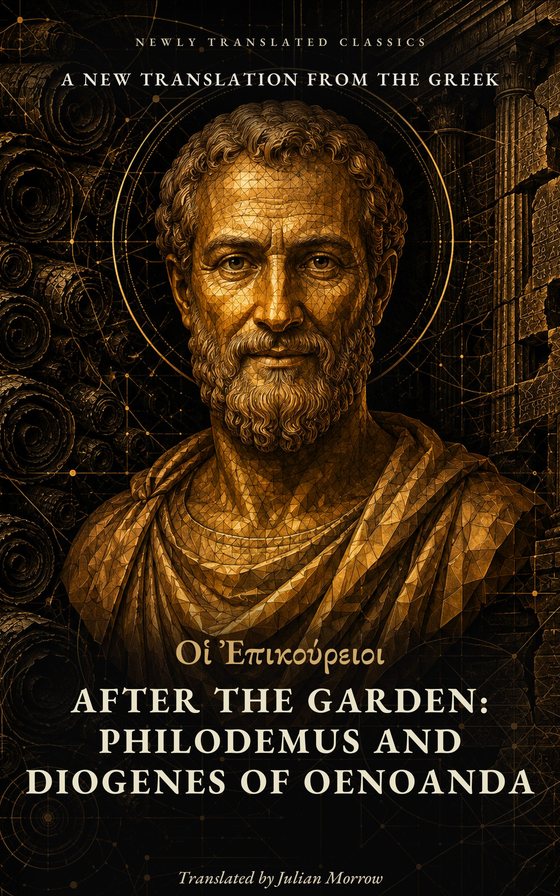
After the Garden: Philodemus and Diogenes of Oenoanda
Translated by Owen Halloway